
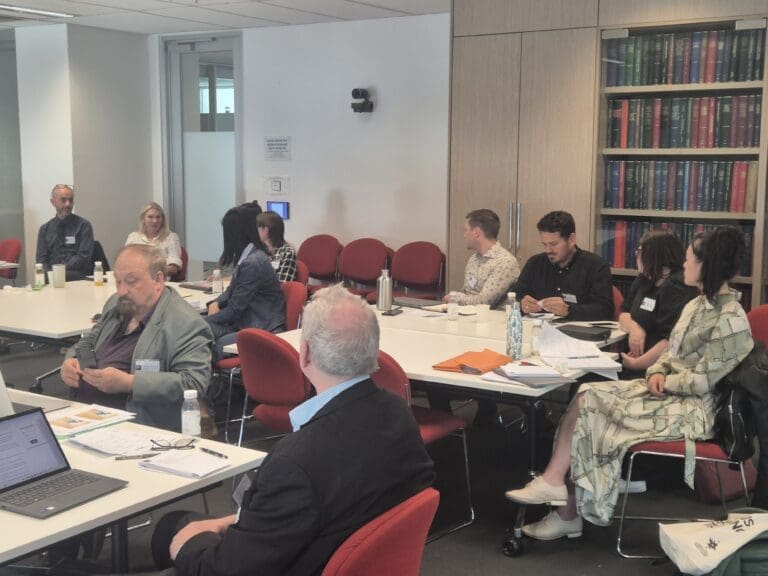
The European Studies Association of Australia and New Zealand (ESAANZ) held its 2025 conference in a hybrid format at the University of Melbourne, Australia on 21 November 2025.
Conference theme:
Continuity and change: Europe in time of heightened geopolitical uncertainty
In this current time of heightened geopolitical uncertainty – due to the continuing military confrontation in Ukraine and the Middle East, and the increasing military incursions into the NATO territory – the recent behaviour of the European Union has been characterised by continuity and change[1]. Our conference is an invitation to critically examine Europe’s place in the global order and the European Union’s evolving role in global affairs: From the continuity and resilience of its institutions to the recalibration of its various policy, including foreign policy and further enlargement. This conference will explore how Europe navigates the tension between enduring values and the imperative for strategic adaptation in response to military threats. As European Commission President Ursula von der Leyen recently declared, “Europe must fight for its place in a world” thus underscoring the urgency of rethinking both Europe’s geopolitical posture, and capacity for unity in the face of increasing fragmentation.
In this context, the ESAANZ 2025 conference focused on the complexities of Europe’s continuity and change in time heightened geopolitical uncertainty from a variety of perspectives: politics, economy, environment, society, and foreign affairs. The conference organisers invited papers across the broad spectrum of disciplines relating to Europe in these transformative times.




Open Issue of ANZJES
If you would like your paper to be considered for an open issue of the Australia New Zealand Journal of the European Studies please submit the full paper through its submission system.
Full Program:
8:30am – 8:45am Registration
8:45am – 9:00am Welcome address – TBC
9:00am – 10:30am Panel 1: Jean Monnet Policy Network “Challenges and opportunities for EU heritage diplomacy in Ukraine (HER-UKR)” on digital diplomacy of Ukraine at times of war, University of Canterbury (online)
10:30 – 10:45 Morning Tea
10:45 – 12:00 Concurrent sessions
| Panel 2.1: Europe in the Asia Pacific (Chair: Serena Kelly), Conference room | Panel 2.2: Social Issues and Europe (Chair: Gosia Klatt), level 8 meeting room |
| Hyowon Park, (Korea University) Resilient Cooperation for Peace: Middle-Power Diplomacy of the EU, Korea, and Australia in Pursuit of SDG 16May Simpson, Jasmine Barry, Serena Kelly, Mathew Doidge, and Dimitrii Ustinov (University of Canterbury) (online) ‘From Berlin to the Pacific: narratives on Germany in the Pacific Media’Shruti Mishra (Korea University) (online), Shared Interests Among Strategic Differences: Looking at the Emerging EU-India Partnership Through the Lens of Geopolitics | Min Lee (Korea University) Lessons from the European Court of Human Rights for Addressing Technology-Facilitated Gender Based Violence in East AsiaArthur Simonet (Australian National University) (online) Addressing the European Union’s Democratic Deficit: The Case for Strengthening Civic EducationDominika Ohana, Ros Cameron, Syed Mohyuddin (Torrens University Australia) (online) “European Highly Skilled Female Migrants in Australia: Should I Stay or Should I Go Now?” |
12:00 – 12:30 Lunch
12:30 – 13:45 Panel 3: Focus on Finland (Chair: Daniela Aquaro)
Perspectives of the Master of Education students on Finland and its Education System: Justin Guiler, Maria Bilske, Pedro Mello, Jessica Yang (University of Melbourne)
13:45-15:00 Panel 4: European Union’s policy challenges (Chair: Matt Harvey)
15:00 – 15:15 Coffee break
15:00 – 16:15 Panel 5: European Union as a global and local actor (Chair: Serena Kelly)
16:15 – 17:00 Panel 6: Australian Institute of Polish Affairs (AIPA) Panel discussion – Populist politics and society – example of Poland. (Chair: Gosia Klatt)
17:00 Concluding Remarks

Created and maintained by ScorpioTek